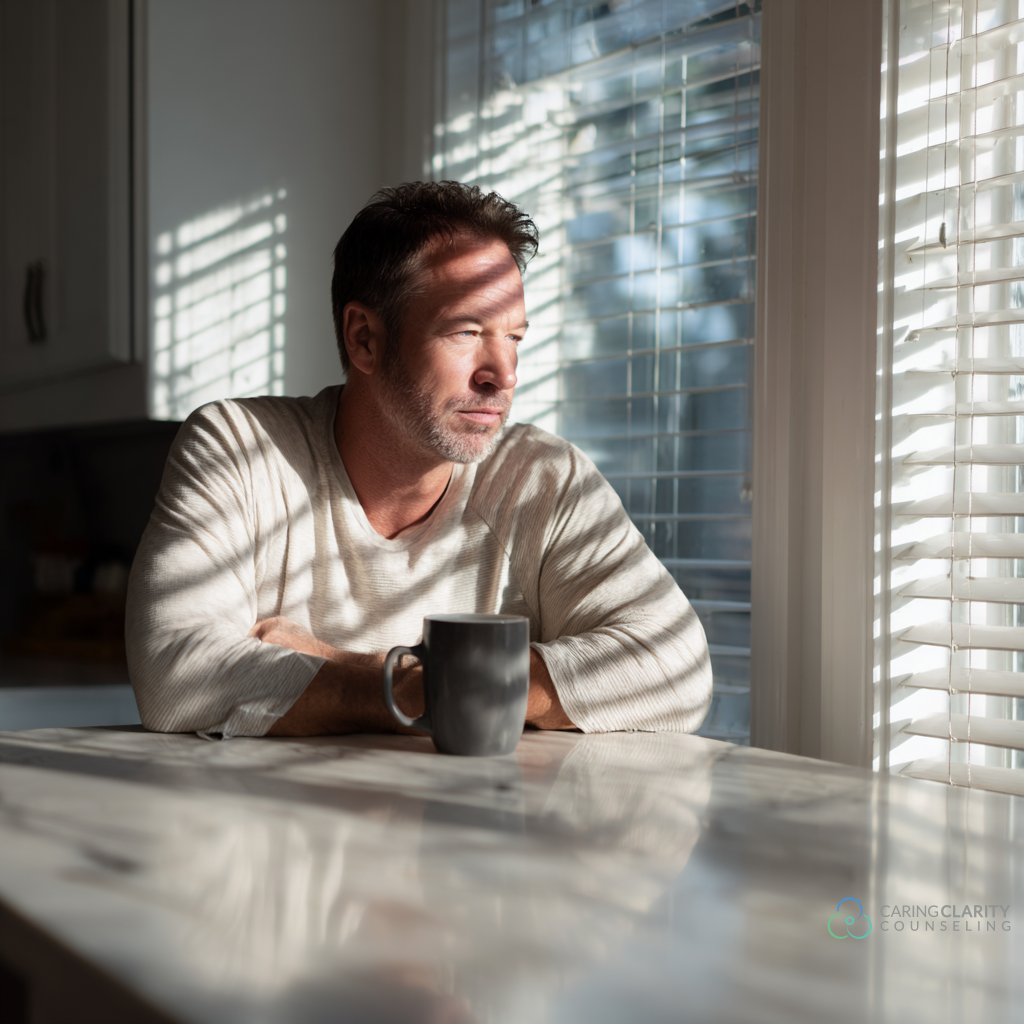
There’s something deeply human about craving rhythm in our lives. Routine. The knowing of what comes next, the comforting predictability of certain footsteps on the stairs, the way a room feels at the same hour each morning. It’s not about monotony—it’s about meaning. Anchors. And when those anchors are yanked up without warning, when life suddenly loses the scaffolding that holds us steady, it can shake even the steadiest among us.
I was struck recently by something Seth Meyers said. For the first time in a long time, I felt like someone with a big platform had given language to a quiet truth so many carry in their day-to-day: that the work we do, especially the creative work that connects us to others, isn’t just something we produce—it produces something in us. A structure. A lifeline. A mirror. Without it? As Meyers himself put it, he’d understandably be concerned for his own mental health.
That honesty—that kind of emotional fluency—deserves a moment. Not just because it came from a public figure, but because it came from a man who thrives in the spotlight, yet knows better than to ignore the subtler, internal stage where our emotional lives play out.
Let’s talk about it.
—
We often underestimate the role structure plays in mental health. Whether it’s a late-night talk show, a 9-to-5 job, or the morning ritual of walking your dog around the block—these small and large routines carry us through the unpredictable parts of life. They tether us to time, purpose, people.
For someone like Meyers—who’s been at the helm of “Late Night with Seth Meyers” for nearly a decade—that structure is more than just a schedule. It’s an extension of his creative self, his identity, and perhaps most importantly, his community. When he talks about the importance of this outlet, he’s pointing to something I’ve seen over and over again in my 20+ years as a counselor: we need places to belong, to express, to matter.
And that doesn’t have to mean hosting a late-night show. For one of my clients—let’s call her Janette—it meant running a weekly poetry circle at her local library. For another, it was the bread-baking business he started out of his garage after retiring early. These weren’t just hobbies. They were expressions of soul and self. They were handrails on the staircase of life, particularly on the hard days when everything else felt uncertain.
What happens when those handrails disappear?
Grief, often. Sometimes depression. And not always in loud, dramatic ways. Grief can whisper. A disorientation that shows up as irritability. Trouble sleeping even though the days feel empty. A sadness that’s hard to name because technically, “you have more time now”—but less purpose.
Meyers didn’t sugarcoat it: if his show were canceled, he knows he’d be mentally and emotionally affected. That awareness is powerful. Too often, people in high-pressure or highly-visible roles are expected to “grind through” loss and change, to pivot without pause. But when a core part of your identity shifts—even if it’s a “job” on paper—it affects the whole ecosystem inside you.
Especially for creatives.
See, creativity isn’t just about producing. It’s also about processing. Let me say that again, for anyone who needs to hear it today: creativity is processing. We write, we joke, we build, we design—not just to perform, but to digest life. To metabolize emotion. So when the outlet disappears, it can feel like emotional constipation (not the prettiest phrase, but true nonetheless).
That’s why routine paired with creative expression is such a powerful elixir for mental health. It provides not only structure, but movement. And movement is life. Emotion, after all, comes from “e-motion”—energy in motion. Without it, we get stuck. Spinning mentally, spiritually, sometimes physically.
So what can we learn from Seth Meyers’ vulnerability?
First, that it’s okay—no, essential—to acknowledge the emotional stakes of our work. Even if it’s not glamorous. Even if it’s not paying the bills in the way society says it “should.” If it makes you feel grounded, lit up, part of something—it’s real, and it matters.
Second, we need to be proactive. We can’t always control what’s taken from us—jobs end, roles shift, studios close—but we can plant seeds for what keeps us well. It might be finding a creative group outside of work, volunteering somewhere that lights you up, or finally picking up that paintbrush that’s been sitting in the closet since 2019.
And third, connection is crucial. Meyers emphasized the value of his team. The shared life that gets built when you create with others. The secret isn’t just the work—it’s the people you laugh with while doing it. Never underestimate the power of shared purpose and mutual encouragement. If you’ve found that in a workplace, a friend group, a knitting circle—protect it. Nurture it. It’s medicine.
—
I’m writing this as someone who wears two hats: a copywriter who’s danced at the intersection of words and ideas for decades, and a licensed counselor who’s walked alongside thousands of people navigating the emotional terrain of identity, loss, purpose, and transformation.
What I’ve learned is this: none of us are built to run on empty. We don’t thrive in chaos. We don’t grow in isolation. We need rhythm. We need spaces to contribute. We need roles that feel like home.
And when those things shift—and they inevitably will—it’s not a sign of weakness to feel the impact. It’s a sign of being beautifully human.
So if you find yourself in a season of change—maybe the job ended, or the creative flame dimmed, or the structure that once held you isn’t there anymore—I want you to hear this: there is a way forward.
It won’t look the same as what was. That’s true. But it can still be rich. Still be meaningful. Still be yours.
Start small. Do something weekly that brings just a flicker of that aliveness back. Call someone who cares about the same weird niche thing you do. Create a gentle routine that helps you mark time when everything else feels unmoored.
And remember, as Seth Meyers did, to speak the truth—not just of what you do, but of what it gives you.
That’s where healing begins. That’s where stability grows. That’s where we reclaim our place in the rhythm of things.